How Pharmacy Management Software Makes Daily Operations Easier
Running a pharmacy involves much more than selling medicines.
There are deliveries to check, shelves to restock, expiry dates to monitor, suppliers to contact and sales to record. On a busy day, even a small mistake can create extra work for the team.
For pharmacy owners, keeping everything organised can be one of the most demanding parts of running the business.
That's where pharmacy management software can make a difference.
The Everyday Challenges of Running a Pharmacy
Imagine a customer comes in asking for a particular medicine. The employee checks the shelf but cannot find it.
Is the medicine out of stock? Is there more in storage? Was it sold earlier without the inventory record being updated?
Without accurate stock information, answering a simple question can take longer than it should.
Now consider the other tasks happening throughout the day: checking deliveries, recording purchases, preparing bills and monitoring products approaching their expiry dates.
When information is spread across notebooks, spreadsheets and separate systems, it's easy to lose track of important details.
Keeping Medicine Stock Organised
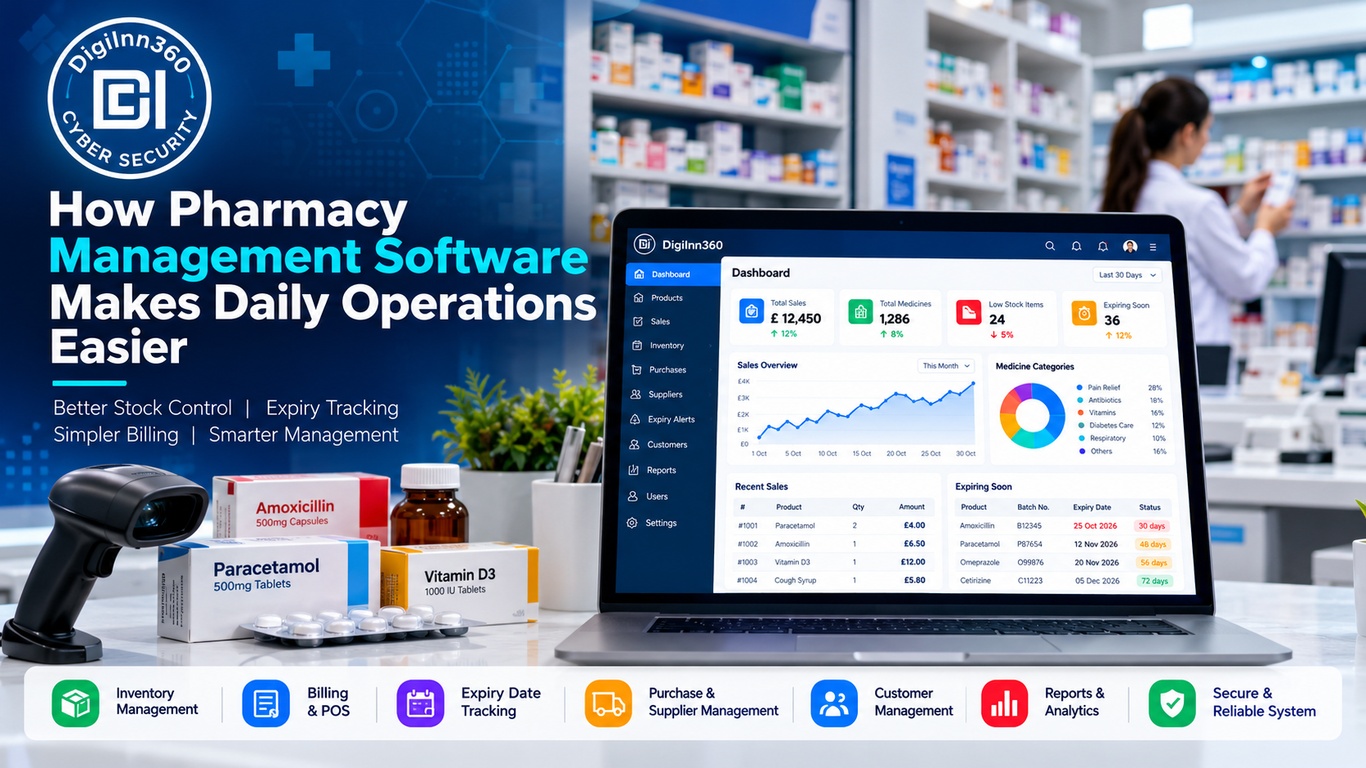
One of the most useful features of pharmacy management software is inventory tracking.
Instead of relying entirely on manual stock counts, a digital system can help employees record incoming medicines, update quantities after sales and identify items that need to be reordered.
For example, if a commonly requested product is running low, the system could flag it before the pharmacy runs out.
This gives owners a clearer picture of their inventory and helps employees spend less time searching for information.
Of course, the information is only reliable when stock movements are recorded correctly and physical inventory is checked regularly.
Keeping an Eye on Expiry Dates
Expiry-date monitoring is another important part of pharmacy operations.
Medicines may arrive in different batches, each with its own expiry date. Tracking these manually can become difficult, particularly when a pharmacy carries hundreds or thousands of products.
A well-designed pharmacy system can record batch details and help staff identify medicines approaching expiry.
This can support better stock rotation and reduce avoidable waste.
However, software alerts are not a replacement for proper physical checks, safe storage procedures or professional pharmacy responsibilities.
Making Billing and Sales Records Easier
During busy hours, employees need a billing process that is quick and straightforward.
A pharmacy billing system can help record sales, calculate totals, generate receipts and update inventory records.
It can also give the owner a clearer view of daily transactions.
Rather than manually adding up figures at the end of the day, management can review recorded sales information in one place.
The goal isn't to make the process complicated. It's to help employees complete everyday tasks with fewer unnecessary steps.
Managing Suppliers and Purchases
Pharmacies often work with multiple suppliers.
Keeping track of what was ordered, what arrived and how much was paid can become time-consuming when records are scattered.
A digital purchase management system can help organise supplier information, purchase records, quantities and costs.
This makes it easier to review previous orders and understand purchasing patterns.
For a growing pharmacy, having organised records can also make financial and inventory reviews more manageable.
Understanding How the Business Is Performing
Many business owners know how busy their pharmacy is, but that doesn't always mean they have a clear picture of its performance.
Which products sell most frequently? Which items are sitting in stock? How much inventory has been purchased recently?
Software reporting can help answer these questions using recorded business data.
With better visibility, owners can make more informed decisions about purchasing, stock levels and everyday operations.
Software Should Fit the Pharmacy, Not the Other Way Around
Not every pharmacy works in exactly the same way.
A small independent pharmacy may need a straightforward system for billing, inventory and expiry tracking.
A larger business with multiple locations may need centralised reporting, different staff permissions and more detailed purchasing workflows.
That's why understanding the business comes before choosing or developing software.
A useful system should reflect how employees actually work, rather than forcing them through unnecessary steps.
Security and Reliability Matter Too
Pharmacy software may contain commercially sensitive information and, depending on its functions, personal or health-related data.
That makes security an important consideration.
Appropriate staff permissions, secure authentication, backups, reliable data handling and system maintenance should be part of the planning process.
Any system handling regulated information also needs to meet the applicable legal and professional requirements in the markets where it operates.
At Digi-Inn 360, our cybersecurity background helps inform how we approach these considerations when discussing business software solutions.
How Digi-Inn 360 Can Help
At Digi-Inn 360, we're expanding our work in custom business software alongside our cybersecurity services.
We're particularly interested in helping businesses solve practical problems that take up time every day.
For pharmacies, that might mean improving inventory visibility, organising purchasing records, simplifying billing or making expiry-date monitoring easier.
Our approach starts with a conversation about how the business currently operates, what isn't working well and which improvements would make the biggest difference.
From there, we can explore an appropriate software solution based on the organisation's requirements.
Thinking About Improving Your Pharmacy Operations?
If you're running a pharmacy and finding it difficult to manage stock, purchases, sales or expiry dates, it may be worth reviewing how your current processes work.
You don't necessarily need to change everything at once.
Sometimes, improving one important part of the business is the best place to start.
Contact Digi-Inn 360 to discuss your pharmacy's operational challenges and explore how the right software could help.